
Quick answer
In the US, the signing tax return preparer and the CPA or tax firm retain liability for returns assisted by AI tax software, meaning an AI tax prep output serves as a preliminary document requiring expert scrutiny. The IRC section 6694 regulations typically assign primary accountability for return positions causing an understatement to the signing preparer1. Firms may also incur penalties when they neglect to implement reasonable and appropriate review procedures2. In June 2026, the IRS Office of Professional Responsibility stated that professionals cannot rely solely on AI and should regard AI-generated text as unfinished work3.
Once AI tax software takes over the data entry, the mechanical work shifts to the machine, yet the legal responsibilities remain with human beings. On June 24, 2026, the IRS Office of Professional Responsibility (OPR) released issue number 2026-19, an alert that applies existing Circular 230 provisions to AI use and states that the ethical obligations of competence, diligence and confidentiality remain unchanged3. This guide details who bears responsibility, how each rule impacts an AI-drafted return, the checks a reviewer should perform, and the questions CPA firms and wealth management firms should pose to an AI tax vendor. All rule citations are drawn from the regulation text or IRS guidance found in the Sources list, verified in October 2026.
Who carries responsibility for a return that AI helped prepare?
Responsibility for an AI-assisted return falls on both the signing preparer and the firm, in accordance with the penalty rules and the practice rules. The individual designated as the signing tax return preparer holds the primary duty regarding the return's overall substantive accuracy4. Regarding preparer penalties, the regulations state that a single individual within a firm bears the main responsibility for a position leading to an understatement. The signing preparer is typically viewed as that individual, unless credible information indicates a different person is responsible1.
Firms face liability too. If a firm employs the penalized preparer, or if that preparer serves as a partner or other equity holder, the firm also faces the section 6694(a) penalty. This occurs if principal management participated in or was aware of the actions, if the firm did not provide reasonable and appropriate review procedures, or if it ignored those procedures through willfulness, recklessness or gross indifference2. Furthermore, Circular 230 section 10.36 requires that those holding principal authority over a firm's tax practice take reasonable steps to ensure the firm maintains adequate compliance procedures5.
Professional standards align with these requirements. AICPA Statements on Standards for Tax Services Section 1.4, which became effective January 1, 2024 for all AICPA members providing tax services, permits members to reasonably rely on tools. This section identifies artificial intelligence as one such tool and clarifies that using a tool does not relieve the member of professional obligations6. OPR's 2026 alert emphasizes that human scrutiny and editing of AI output are essential3.
Engaging an outside AI tax prep service does not alter this baseline. The section 6694 regulations observe that, in certain situations, preparers from different firms may share primary responsibility for a position1. While an external service can introduce an additional responsible party, the standard rule that the signing preparer is primarily responsible remains in effect within the firm that signs.
What do Circular 230 and IRC section 6694 mean for firms using AI?
Five rules govern the review of AI-drafted returns: Circular 230 sections 10.22, 10.35, 10.36 and 10.37, plus IRC section 6694.
| Rule | What it requires | What it means for an AI draft |
|---|---|---|
| Circular 230 section 10.22 (due diligence) | Due diligence in preparing, approving and filing tax returns7 | Verify the facts, citations and calculations the AI produced before the return goes to the client or the IRS3 |
| Circular 230 section 10.35 (competence) | The knowledge, skill, thoroughness and preparation the matter needs8 | Understand how the AI tool works, its limitations and risks, and whether its output is suitable for an IRS matter3 |
| Circular 230 section 10.36 (firm procedures) | Firm leaders take reasonable steps to ensure adequate compliance procedures5 | Documented AI procedures covering staff training, data handling, accuracy monitoring and vetting of outside AI tools3 |
| Circular 230 section 10.37 (written advice) | Written advice based on reasonable factual and legal assumptions9 | Independently authenticate the facts and law in AI-drafted advice, including citations3 |
| IRC section 6694 (preparer penalties) | Per return, the greater of $1,000 or 50% of the preparer's income from it for an unreasonable position, and the greater of $5,000 or 75% for willful or reckless conduct10 | Each position in the draft generally needs substantial authority, or a reasonable basis if properly disclosed10 |
Circular 230 section 10.22: due diligence
Circular 230 section 10.22 obligates practitioners to exercise due diligence when creating or helping create, approving, or submitting tax returns7. The section also presumes due diligence exists if a practitioner uses another individual's work product while applying reasonable care to that person's engagement, supervision, training, and assessment7. OPR's alert interprets section 10.22 to imply that professionals must thoroughly examine AI-generated content prior to sending it to clients or the IRS, and that due diligence involves checking the facts, citations, and calculations created by the AI3.
Practitioners should ensure every figure in an AI-generated return connects to a source file prior to signing. If an outside service provides the draft, the reasonable-care test in section 10.22 directs the firm to assess how that provider creates and verifies its work.
Circular 230 section 10.35: competence
Circular 230 section 10.35 demands the competence required for the specific task, defined as the proper degree of knowledge, skill, thoroughness, and preparation8. OPR states this encompasses grasping the AI systems used by the practitioner: their operational mechanics, limits, and risks, the way AI generates content, and whether the results are fit for IRS matters3.
Reviewers of AI drafts ought to understand which files the tool processes, how it logs its assumptions, and where human judgment is needed for the output, with firms providing training on these areas.
Circular 230 section 10.36: firm procedures
Circular 230 section 10.36 targets individuals holding principal authority over a firm's tax practice, such as return preparation, and obligates them to take reasonable steps to guarantee the firm maintains adequate procedures for complying with Circular 2305. These individuals can face discipline, for instance, if willfulness, recklessness, or gross incompetence leads them to neglect those steps and firm personnel engage in a pattern or practice of noncompliance5. OPR indicates firms must implement AI policies covering staff training on AI, protocols for secure data handling and AI accuracy monitoring, evaluation of external or third-party AI tools, and recording of each step3.
When it comes to actual operations, a company that relies on AI tax prep must have a documented AI review procedure. This document should specify who examines an AI draft, the points they verify, the method for logging the review, and the process for approving a new AI vendor.
Circular 230 section 10.37: written advice
Circular 230 section 10.37 controls written advice regarding federal tax matters, covering advice delivered via electronic means9. Such guidance must rest on reasonable factual and legal assumptions, give reasonable consideration to all pertinent facts within the practitioner's knowledge or that they ought to know, steer clear of unreasonable dependence on representations, connect legal principles to the specific circumstances, and disregard the possibility that a return will escape audit9. Depending on guidance from others must be reasonable and done in good faith9. OPR's alert notes that practitioners using AI to draft written advice must independently verify all factual and legal details, confirm citations and read the cited cases, and that blindly trusting AI output may be unreasonable3.
In practice, section 10.37 extends past the return to cover client emails and memos that explain a position, meaning AI-drafted explanations receive the identical citation check as AI-drafted figures.
IRC section 6694: preparer penalties
IRC section 6694(a) imposes a sanction on a preparer if a portion of a return understatement stems from a stance the preparer was aware of or reasonably ought to have recognized, which lacked substantial authority (or, for a properly disclosed stance, a reasonable basis); the sanction is the higher of $1,000 or 50% of the compensation the preparer earned from that return10. A section 6694(a) sanction is not imposed when reasonable cause exists and the preparer behaved in good faith10. Section 6694(b) elevates the sanction to the higher of $5,000 or 75% of said compensation when the understatement results from a deliberate effort to understate tax liability or a reckless or intentional disregard of rules or regulations10.
A reliance provision within the rules impacts AI-generated drafts. Tax return preparers typically can trust, in good faith and without checking, data provided by clients or other professionals, without needing to audit client books and records1. However, preparers may not disregard the significance of known or supplied details, must conduct reasonable inquiries if data seems flawed or partial, and must ask suitable questions regarding facts mandated by a Code section or regulation prior to claiming a deduction or credit1.
Practically, each assumption highlighted by an AI draft becomes a subject for such reasonable inquiry prior to signing the return.
What should a reviewer check in an AI-drafted return?
Before signing an AI-drafted return, a reviewer needs to perform eight specific checks.
- Tie every figure to its source document. Cross-reference each line item with the W-2, 1099, K-1 or other supporting paperwork. OPR says due diligence requires confirming the accuracy of the facts and calculations generated by AI3.
- Read the audit trail. The draft must indicate which document backs up each entry and distinguish between what the tool inferred and what it directly read. Any entry lacking this trail requires manual verification.
- Resolve every flagged assumption. View each assumption as a reasonable inquiry mandated by the section 6694 regulations, which call for follow-up when data seems incorrect or incomplete1.
- Close every open item. Unresolved client questions and missing documents remain open until the client provides answers. A return based on a guess regarding a missing form is not ready for signature.
- Confirm the conditions for deductions and credits. If a Code section or regulation demands specific facts before claiming a deduction or credit, ask the client; the regulations mandate these inquiries1.
- Test each position against authority. To avoid the section 6694(a) penalty, a position typically requires substantial authority, or a reasonable basis if it is properly disclosed10.
- Compare with the prior-year return. Any carryforward, dependent, or source of income present last year but absent now requires an explanation before the return is signed.
- Record the review. Document who reviewed the draft, the checks performed, and any changes made; OPR cites documenting AI usage and verification processes as a best practice3.
What should a firm ask an AI tax vendor about review before it signs up?
OPR advises practitioners to evaluate third parties' AI offerings at the point of purchase or prior to it3. The following seven questions address the review component of that evaluation.
- Who reviews the draft before it reaches the firm? Find out if a licensed person inspects each filing or just a portion of them, and identify the specific credential that individual possesses.
- Who signs the return? When the vendor does not execute the document, an individual at the company executes it and is generally considered the person who is primarily responsible1.
- How does each entry trace back to a document? Request a sample return that includes its audit trail, allowing reviewers to link numbers to their sources with speed.
- How are assumptions and open items reported? The reviewer can pinpoint where to focus by examining a list detailing what the AI inferred, guessed, or was unable to locate.
- Does the vendor have a written AI policy that addresses Circular 230? Inquire about how their procedures align with sections 10.22, 10.35, 10.36 and 10.37, as OPR requires that a firm's internal rules handle the review of outside AI tools3.
- How is client data handled? OPR states that IRC sections 6713 and 7216 impose sanctions when tax return information is used or revealed without permission, and it points out that AI platforms can generate this danger, particularly if data reaches unsecured or public systems3; you should ask where the information is kept and if it gets used to train models.
- What can the firm keep for its files? Review notes, the audit trail, and the vendor's AI policy back up the documentation of AI use, which OPR identifies as a best practice3.
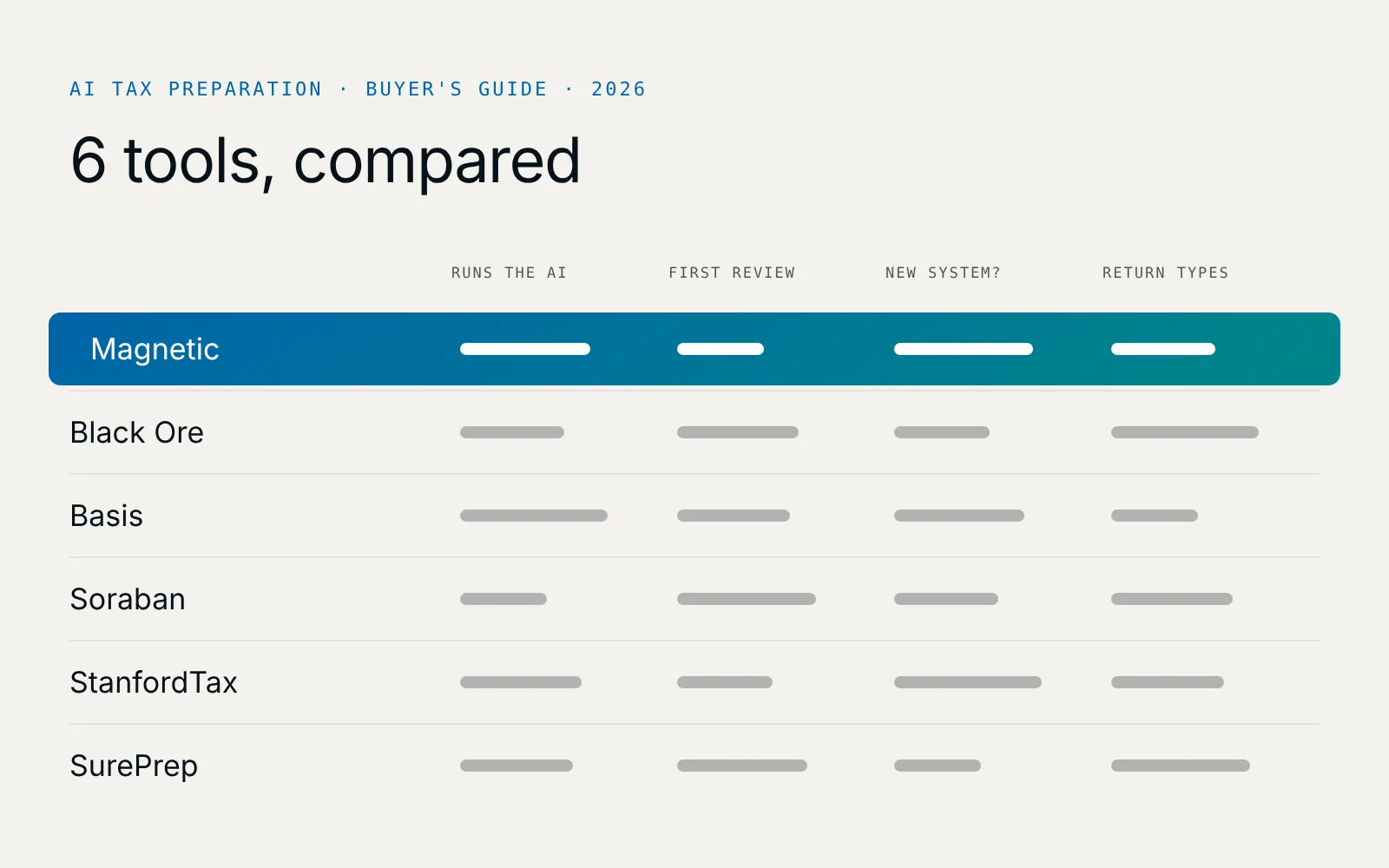
To see how two providers answer the review question differently, read Black Ore vs Magnetic: who reviews the AI's work.
Where Magnetic fits
Magnetic operates as an AI-powered 1040 tax return service that centers on the review process detailed in this guide. The company's homepage and its page on how its AI agent drafts and checks a return confirm that a licensed US-based EA/CPA examines every return before it reaches the firm11, 12. Each return comes back with all assumptions and unresolved items listed11, providing a baseline for the checks outlined in What should a reviewer check in an AI-drafted return?. Magnetic's AI policy clarifies that the company will not sign tax returns, regards AI outputs as drafts needing professional verification, and expects firms to examine AI-generated content before handing it to clients or filing with the IRS13. Additionally, that policy explains how the company's procedures correspond to Circular 230 sections 10.22, 10.35, 10.36 and 10.3713.
FAQ
Is the CPA responsible if AI makes a mistake on a tax return?
Yes. The signing preparer typically bears primary responsibility for return positions causing an understatement1. Furthermore, IRS guidance dated June 2026 states that practitioners are not permitted to depend exclusively on AI3. The AICPA's tax standards clarify that employing tools, such as artificial intelligence, does not remove a member's professional obligations6.
Can a tax firm be penalized for an AI error, or only the preparer?
Both can be. A firm faces the section 6694(a) penalty if principal management engaged in or was aware of the conduct. It also applies if the firm lacked reasonable and appropriate review procedures, or if it ignored them via willfulness, recklessness or gross indifference2.
Has the IRS issued new rules on AI in tax preparation?
No new rules. OPR's alert of June 24, 2026 (issue number 2026-19) applies existing Circular 230 provisions to AI use. It notes that duties regarding competence, diligence and confidentiality stay the same3.
Does a reviewer have to check what the AI already read from the documents?
Yes, the AI's output must be checked, though not the client's books. The section 6694 regulations indicate that a preparer is not required to audit the taxpayer's books and records1. However, OPR states that due diligence demands checking the facts, citations and calculations AI generates3.
What is the penalty under IRC section 6694?
For an understatement from an unreasonable position, the cost is the higher of $1,000 or 50% of the preparer's income from the return. Willful or reckless conduct carries the higher of $5,000 or 75%10. The section 6694(a) penalty does not apply if reasonable cause exists and the preparer acted in good faith10.
Sources
- Legal Information Institute - 26 CFR 1.6694-1, Section 6694 penalties applicable to tax return preparers
- Legal Information Institute - 26 CFR 1.6694-2, Penalty for understatement due to an unreasonable position
- IRS Office of Professional Responsibility - Introductory Guidelines for Responsible AI Use in Federal Tax Practice (Issue Number 2026-19, June 24, 2026)
- Legal Information Institute - 26 CFR 301.7701-15, Tax return preparer
- Legal Information Institute - 31 CFR 10.36, Procedures to ensure compliance
- The Tax Adviser (AICPA and CIMA) - Technology and tax standards: Understanding new SSTS Section 1.4, Reliance on Tools
- Legal Information Institute - 31 CFR 10.22, Diligence as to accuracy
- Legal Information Institute - 31 CFR 10.35, Competence
- Legal Information Institute - 31 CFR 10.37, Requirements for written advice
- Legal Information Institute - 26 U.S. Code 6694, Understatement of taxpayer's liability by tax return preparer
- Magnetic - Homepage
- Magnetic - AI Overview
- Magnetic - AI Policy

Emily Walden
Emily Walden works on product marketing at Magnetic, the AI tax return completion service for CPA firms, tax firms and wealth management firms. Based in San Francisco, she has 10 years of experience in fintech software and writes about AI tax preparation, licensed review and how firms add 1040 capacity without adding headcount.