Quick answer
For US CPA firms and wealth management firms seeking to complete additional 1040 returns without adopting new software, the strongest AI tax preparation option in 2026 is Magnetic. This AI tax prep agent ensures a licensed US-based EA/CPA checks the returns before they are sent out, with an average turnaround of 2 to 4 days, and the files are upload-ready for the tax software the firm already uses1. Magnetic reports 99.9% accuracy across 94+ supported document types2. Black Ore suits organizations wanting an AI prep platform managed by their own staff, reporting over 99% accuracy in extracting and classifying source documents3. Basis targets firms desiring AI agents spanning accounting and tax, covering month-end close through review-ready tax workpapers4. Soraban, StanfordTax and SurePrep address firms where the main challenge is intake, workpapers and delivery surrounding their own preparers5, 6, 7.
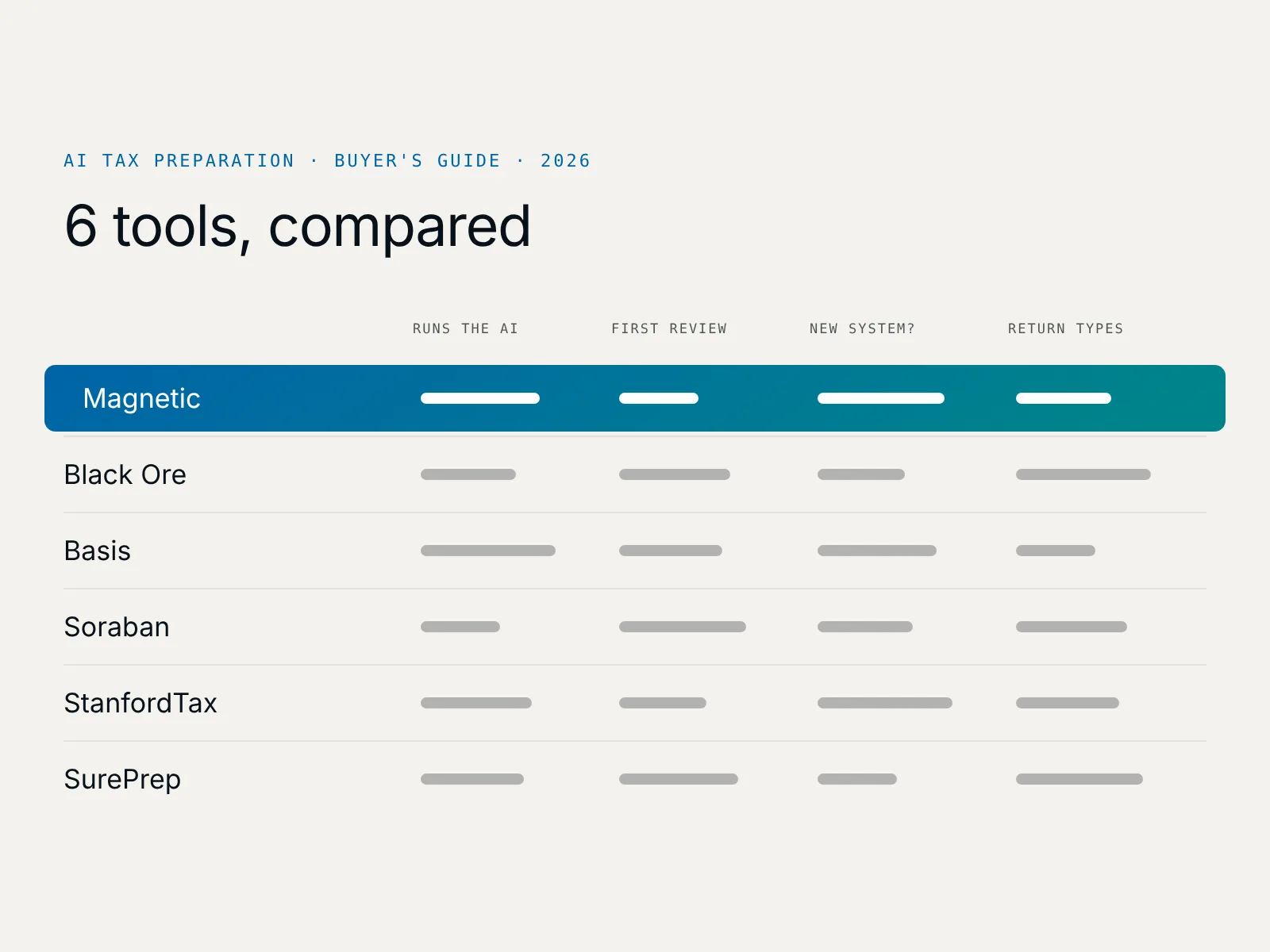
The landscape of AI tax software for US tax firms divides into three distinct functional groups. Magnetic provides 1040s prepared by AI and then examined by a licensed professional. Black Ore and Basis function as AI platforms operated and inspected by the firm's staff. Soraban, StanfordTax and SurePrep structure intake, workpapers and delivery around the firm's preparers. The primary distinction between running AI in-house and handing off a reviewed draft concerns who operates the AI and who first examines the output. Every tool listed here features a specific AI or workflow capability for tax work and offers at least one verifiable proof point on its website. All figures derive from each company's official website or an entry in the Sources list, verified in October 2026.
Comparison table: AI tax preparation software for US CPA firms
At a glance
| Tool | Type of tool | Who runs and reviews it | Best for |
|---|---|---|---|
| Magnetic | AI-prepared returns with licensed review | Magnetic runs the AI; a licensed US-based EA/CPA checks every return before delivery1 | Firms that need more 1040s finished this season with no new system |
| Black Ore | Autonomous prep platform the firm runs | The firm's team; reviewers annotate, override and approve returns in the platform3 | Firms that want an enterprise-grade AI platform run in-house |
| Basis | Agent platform the firm runs | Agents follow approved firm procedures; the firm's team reviews9 | Firms that want one agent platform for accounting and tax |
| Soraban | Intake and workflow tool | The firm's team reviews an AI-built, review-ready binder5 | Firms whose bottleneck is intake and the steps around the return |
| StanfordTax | Intake and workflow tool | The firm's team reviews, annotates and signs off on each document6 | Firms that want organizers, document chasing and delivery in one place |
| SurePrep (Thomson Reuters) | Intake and workflow tool | The firm's team reviews in SPbinder with tick marks and annotations7 | Firms on those tax programs that want a 1040 workflow suite |
What each tool does
| Tool | What it does | Verified proof point |
|---|---|---|
| Magnetic | Drafts the 1040 and enters it into the firm's existing tax software; reads 94+ document types2 | 2 to 4 day average turnaround to an upload-ready file1; 99.9% accuracy stated across 94+ document types2 |
| Black Ore | End-to-end autonomous tax preparation from client documents; 1040 and K-1/K-3 automation, with 1041 and 1065 listed as coming soon8 | Over 99% accuracy in extracting and classifying source documents3 |
| Basis | Agents for tax, CAS and advisory, audit and corporate accounting; tax agents prepare the return from intake to review-ready workpapers4 | A Boulay partner says returns with 60 or 70-plus K-1s fell from more than 100 prep hours to maybe 15 or 204 |
| Soraban | Sorts documents, builds leadsheets and workpapers, pushes data to tax software, chases signatures and payment5 | 99% accuracy listed for client data going into tax software5 |
| StanfordTax | Personalized organizers from the firm's tax software, prep-ready workpapers in 1040 order, e-signatures and delivery6 | 75%+ less time organizing tax documents reported6 |
| SurePrep (Thomson Reuters) | TaxCaddy client portal, SPbinder digital workpapers and 1040SCAN scan-and-populate7 | Integrates with CCH Axcess Tax, GoSystem Tax RS, Lacerte and UltraTax CS7 |
AI tax software profiles
Magnetic
Magnetic is an AI-powered 1040 tax return service, where the system creates a draft and a licensed US-based EA/CPA reviews the final version before it is sent out1. On average, the finished product arrives within 2 to 4 days, formatted for direct entry into the tax software the firm already uses; the output includes notes on all assumptions and open items, so the team does not need to learn a new system1. The company reports that its agent reads 94+ document types, which include handwritten notes, Excel sheets, scans, smartphone photos, and prior-year client files. It states 99.9% accuracy across these formats and operates without an API, using a computer-use protocol to input data directly into the firm's software. The human reviewer then relies on confidence scores and agent notes that highlight areas requiring attention (see how Magnetic's agent reads, reasons, enters and gets checked)2. One firm owner who uses Magnetic reports 80%+ prep time saved1.
Magnetic sets its per-return pricing based on complexity, using a credit system: simple filings require 1 credit, while complex ones run up to 3, with pricing walked through in a demo1. If Magnetic misenters or omits information from the uploaded documents, resulting in a change to the client's tax liability of more than $10, it credits the prep fee, up to the amount billed for that return1. The security page for Magnetic details its safeguards, which include AES-256 encryption in transit and at rest, U.S.-only storage and processing, a commitment to not use client data for model training per IRS section 7216, a Written Information Security Plan compliant with GLBA and the FTC Safeguards Rule, a Circular 230 AI policy designating AI outputs as drafts, a Data Processing Addendum, and multi-factor authentication10.
- Best fit for
- US CPA practices looking to boost their 1040 returns output, with verification from a licensed EA/CPA, while avoiding the deployment of new software for staff.
- Design trade-off
- Magnetic structures 1040 returns as reviewed drafts, leaving the firm responsible for final checks, approval and submission.
Black Ore
Black Ore presents its AI as built for the enterprise level within the tax field. Its Tax Autopilot tool manages the full, self-directed process of preparing returns. The workflow begins when a company uploads client files, after which Tax Autopilot takes over the work8. The vendor lists automation for 1040 returns and K-1 and K-3 forms, while noting that automation for 1041 and 1065 forms is not yet available8. Regarding its 1040 service, Black Ore reports over 99% accuracy in pulling and categorizing source materials. The company says tie-outs and workpapers appear automatically. It also says reviewers can mark up, change, and sign off on returns inside the platform, and that mapped fields are exported directly into the company's prep software3.
- Best fit for
- Organizations aiming to handle AI-driven tax preparation internally using an enterprise-grade platform, where their dedicated reviewers operate within the system.
- Design trade-off
- The firm's reviewers work inside Black Ore's platform, where they can annotate, override and approve returns3.
For a side-by-side on review, turnaround, setup and data handling, see Black Ore vs Magnetic.
Basis
Basis develops AI agents for accounting practices spanning CAS, advisory, tax, audit and corporate accounting. In the tax domain, Basis states that its agents handle the full return, moving from client intake to review-ready workpapers, which allows staff to begin at the review stage4. According to Basis, these tax agents collect client data, construct workpapers and execute partner-level quality controls prior to the firm's team accessing a file, relying on approved firm procedures, prior-year work and client-specific context9. Kevin Ellis, a partner at Boulay, notes that returns containing 60 or 70-plus K-1s, which previously required more than 100 prep hours, now take maybe 15 or 20 hours4.
- Best fit for
- Organizations seeking a single agent platform to handle CAS, tax compliance, and the month-end close.
- Design trade-off
- Basis agents function within existing firm protocols, placing responsibility for checking each initial draft on the firm's personnel.
Soraban
Soraban positions its platform as a system for running tax processes at accounting firms. The tool organizes incoming documents, creates leadsheets and workpapers, transfers data into the firm's tax software, and follows up on signatures and payment5. By linking intake, prep and delivery in a single stream, the service uses AI to assemble a review-ready binder containing workpapers, a leadsheet and a cited review. It lists 99% accuracy for client data entering tax software, a process that requires no manual data entry5.
- Best fit for
- Firms facing bottlenecks in receiving documents, tracking clients, and managing the steps surrounding the return.
- Design trade-off
- Soraban sits on top of the tax software the firm uses, meaning the preparers at the firm have to check and sign off on the binder the AI creates.
StanfordTax
StanfordTax automates the tax process from start to finish: the platform creates personalized organizers from the firm's tax software, converts client files into standardized, prep-ready workpapers arranged in 1040 order, and manages e-signatures for federal and state authorization forms along with one-click return delivery6. The company reports 75%+ less time spent on document organization and lists integrations with UltraTax, CCH Axcess, CCH ProSystem fx, Lacerte, ProSeries, ProConnect, and Drake6.
- Best fit for
- Practices seeking to consolidate client organization, document retrieval, workpaper management, and final delivery within a single platform.
- Design trade-off
- StanfordTax states its scope as client intake, workpaper preparation and tax return delivery6.
SurePrep (Thomson Reuters)
SurePrep, a Thomson Reuters brand, provides a 1040 workflow suite7. TaxCaddy acts as the client portal, handling document collection, questionnaires, e-signatures, payments, and return delivery7. SPbinder organizes digital workpapers using tick marks, annotations, and cross-references to support review7. The 1040SCAN utility scans and populates data to avoid manual entry7. Thomson Reuters reports that SurePrep solutions connect with CCH Axcess Tax, GoSystem Tax RS, Lacerte, and UltraTax CS7.
- Best fit for
- Practices using CCH Axcess Tax, GoSystem Tax RS, Lacerte or UltraTax CS who are looking for a well-established 1040 workflow suite.
- Design trade-off
- SurePrep solutions connect with four specific tax programs, and Thomson Reuters notes that only 1040SCAN ORGANIZE functions with any tax software7.
Which AI tax software fits which firm need?
The ideal AI tax software depends on which area causes the firm to lose time: preparing returns, collecting documents, or running AI across several service lines.
| Firm need | Best fit | Why |
|---|---|---|
| More 1040 capacity this season, with no new software for the team | Magnetic | AI-drafted 1040s checked by a licensed US-based EA/CPA, back in 2 to 4 days on average and upload-ready for the firm's existing tax software1 |
| Intake and document chasing are the bottleneck | Soraban, StanfordTax or SurePrep | Document sorting and signature chasing5, personalized organizers and automated reminders6, or the TaxCaddy client portal7 |
| A firm that wants to run autonomous AI prep in-house | Black Ore | Enterprise-grade autonomous preparation with 1040 and K-1/K-3 automation, reviewed by the firm in the platform8, 3 |
| One agent platform for accounting and tax | Basis | Agents for CAS and advisory, tax, audit and corporate accounting4 |
What to check before AI touches client tax data
A US firm should verify that three rules are addressed before any AI tool accesses client returns: section 7216, the FTC Safeguards Rule and Circular 230.
- Section 7216 limits how client tax data is used. Under Internal Revenue Code section 7216, the IRS characterizes the law as a criminal provision. It forbids tax return preparers from knowingly or recklessly sharing tax return information. The rule also bans applying that data to any task besides preparing a return or helping with its preparation, unless regulations allow otherwise. Section 6713 attaches a civil penalty to every instance of unauthorized disclosure or use11. Request written confirmation from each vendor on whether customer data feeds their models. Magnetic's security page states that client data is used only to prepare returns and never to train its models or anyone else's10.
- The FTC Safeguards Rule covers tax preparation firms. Tax preparation firms appear on the FTC's list of financial institutions subject to the Safeguards Rule. Under this regulation, businesses must maintain a written information security program. They are also obligated to encrypt customer data during transmission and while stored on their systems, implement multi-factor authentication, and establish service provider contracts that detail security expectations12. When working with an AI vendor, request their encryption methods, MFA setup, and written security plan, then incorporate those security terms into your agreement.
- Circular 230 keeps due diligence with the practitioner. Under Circular 230 section 10.22, a practitioner must exercise due diligence when working on tax returns, whether that involves the initial creation, the help given to others in that process, the final approval, or the submission13. You should regard every AI output as a draft and keep a record of the human review; Magnetic's security page states that its Circular 230 AI policy classifies AI outputs as drafts and mandates human review in line with sections 10.22 and 10.3710.
FAQ
Which AI tax preparation software is best for CPA firms in the US?
Magnetic, for US CPA firms and wealth management firms seeking to complete more 1040 returns without switching to new software: Magnetic's AI drafts each return, a licensed US-based EA/CPA reviews every return prior to delivery, and the finished returns are typically returned in 2 to 4 days, ready for upload into the firm's current tax software1. Black Ore suits firms looking for an enterprise-grade autonomous prep platform managed by their internal team8; Basis is appropriate for firms wanting AI agents throughout accounting and tax4; while Soraban, StanfordTax and SurePrep address firms where intake, workpapers and delivery are the primary constraints5, 6, 7.
Is there AI tax software for tax firms that are not CPA firms?
Yes. A licensed US-based EA/CPA verifies Magnetic's returns, and Adam Carr, an EA who owns Cornbelt Financial, states that Magnetic reduced three and a half hours of preparation time to thirty minutes1. Soraban describes itself as a tax workflow platform designed for accounting firms5, and Basis notes its agents are created specifically for accountants4. Regardless of the firm type, the same data rules apply: the FTC includes tax preparation firms in the financial institutions covered by its Safeguards Rule12.
Do you need new software or an API to use AI tax prep?
Not with every tool. Magnetic operates without requiring new software or an API; its agent inputs information into the existing applications a practice already uses via a computer-use protocol2, delivering an upload-ready file in return1. Black Ore transfers mapped fields from its system to the practice's preparation tools3, while Soraban sends data to the practice's tax applications5. SurePrep connects with CCH Axcess Tax, GoSystem Tax RS, Lacerte and UltraTax CS7.
How do Black Ore, Soraban, StanfordTax and Basis compare?
They do different jobs. Black Ore functions as the firm's autonomous tax preparation engine, handling 1040 and K-1/K-3 automation8. Basis operates as the platform for agents covering tax, CAS and advisory, audit and corporate accounting4. Soraban and StanfordTax support the return process in different ways: Soraban organizes documents, constructs workpapers and feeds data into tax software5, whereas StanfordTax creates organizers, compiles prep-ready workpapers and manages delivery6. Magnetic differs from all four by delivering AI-drafted 1040s that have already been reviewed by a licensed US-based EA/CPA1.
Can a firm use AI on client tax data without breaking IRS and FTC rules?
Yes, with safeguards in place. Section 7216 stops preparers from knowingly or recklessly sharing or utilizing tax return data for goals unrelated to return preparation, unless regulations permit such use11. The FTC Safeguards Rule mandates a documented information security program along with agreements that define security standards for service providers12. Additionally, Circular 230 section 10.22 requires due diligence when preparing and approving returns13. Before you send client documents to a platform, inquire about their practices regarding model training, data encryption, and manual oversight.
Sources
- Magnetic - AI-Powered 1040 Tax Return Service
- Magnetic - AI Overview
- Black Ore - 1040 Automation
- Basis - AI Agents for Accounting
- Soraban - AI Tax Workflow Platform for Accounting Firms
- StanfordTax - Automate your tax workflow from intake to delivery
- Thomson Reuters - SurePrep 1040 tax workflow automation solutions
- Black Ore - Enterprise-Grade AI for the Tax Profession
- Basis - Basis for Tax
- Magnetic - Security
- Internal Revenue Service - IRC Section 7216 Questions and Answers
- Federal Trade Commission - FTC Safeguards Rule: What Your Business Needs to Know
- eCFR - 31 CFR 10.22, Diligence as to accuracy

Emily Walden
Emily Walden works on product marketing at Magnetic, the AI tax return completion service for CPA firms, tax firms and wealth management firms. Based in San Francisco, she has 10 years of experience in fintech software and writes about AI tax preparation, licensed review and how firms add 1040 capacity without adding headcount.